


15 minute read.
In May 2026, Shiv Rao told 20VC that 40% of Abridge’s model outputs now come from in-house models distilled from Meta’s Llama.1 The 60% that remains runs on OpenAI’s API. That detail matters more than the 40% does. OpenAI’s named banner healthcare customers are vertical AI vendors like Abridge, Ambience, and EliseAI: companies with engineering teams, CFO math, and the strategic will to migrate. Anthropic’s named banner healthcare customers are health systems and pharma companies like Banner, Stanford, Genmab, and Novo Nordisk: buyers who structurally cannot in-source. OpenAI sold to vendors. Anthropic sold to buyers. The 40% is the leading indicator that open weights are compressing both.
This article’s observation and prediction is threefold:
Both companies are generational category creators. Both will persist as significant standalone businesses for many years.
Neither achieves the durable-monopoly economics implied by their current valuations: monopolist pricing power relative to peers, or exclusionary network effects of the kind Google has in search or Meta has in social.
As frontier API premiums hollow out, the valuation gap closes through multiple compression countered by expanded revenue lines, not collapse.
OpenAI made a developer-first, platform-vendor bet: its API became the default substrate for the vertical AI gold rush of 2023-2024, and Abridge-class companies built on top. Anthropic made an enterprise-first, direct-to-buyer bet: Claude for Healthcare launched at JPM26 with HIPAA-ready BAA distribution, native CMS/ICD-10/PubMed connectors, and Banner Health’s 55,000-staff “BannerWise” deployment as anchor.2 The Anthropic Partner Network composition (Accenture, Deloitte, PwC, KPMG, Salesforce, all system integrators that sell into health systems rather than into vendors) and the safety-first brand positioning point in the same direction. The customer-base split appears deliberate.
Healthcare workloads bundle into a handful of bounded language transformations: ambient documentation, prior authorization, coding, inbox triage, eligibility screening. Distilled models thrive precisely where the problem and solution spaces are discrete. That is healthcare’s shape as LLM capability has lunged into competence at an expanding range of healthcare tasks.
Two distinct mechanisms compress the frontier here, and they should be named separately.
Distillation
The first is distillation: a vendor builds a student model on Llama, fine-tunes it on the workload, and routes inference to its in-house stack. Vertical AI vendors with engineering capacity and unit-economic incentive run this play. Abridge’s 40%, Perplexity’s Sonar built on Llama 3.3 70B,3 and a May 2025 npj Digital Medicine paper showing an 8B distilled Llama beating its 70B teacher (89.3% vs 76.2%) at less than a quarter of the cost on clinical extraction4 are all this mechanism. Distillation has a flywheel that has been underappreciated. Every Abridge call to a frontier API on a real clinical encounter generates an input-output pair, and those pairs are the training corpus for the student model that eventually replaces the teacher. Frontier providers are paid for inference today, and that inference produces tomorrow’s labeled dataset for the customer’s in-house replacement. The teacher pays for its own student.
Provider Rotation
The second mechanism is provider rotation: builders stay on third-party APIs but route to whoever is cheapest or best on a given workload. OpenRouter is the visible aggregator. Rotation does not require a vendor to in-source; it only requires a cheaper or comparable alternative to exist on the market, which open weights guarantee. Google has priced Gemini aggressively against that floor; Anthropic and OpenAI have declined. Google and Meta can afford to compete that way because AI is not their core revenue; OpenAI and Anthropic have no such cushion.
At population scale, the OpenRouter aggregator shows the rotation mechanism playing out. OpenRouter does not capture direct API connections or in-sourced model deployments; it captures the slice of builder demand routed through a marketplace, an approximation of efficient market behavior on LLM choice. Within that slice the trajectory is sharp: Anthropic’s developer share fell from a dominant first-place position to roughly 15% in 18 months; OpenAI’s fell to 8%; the Chinese open-weight cohort rose from 1% to over 50% over the same period.5
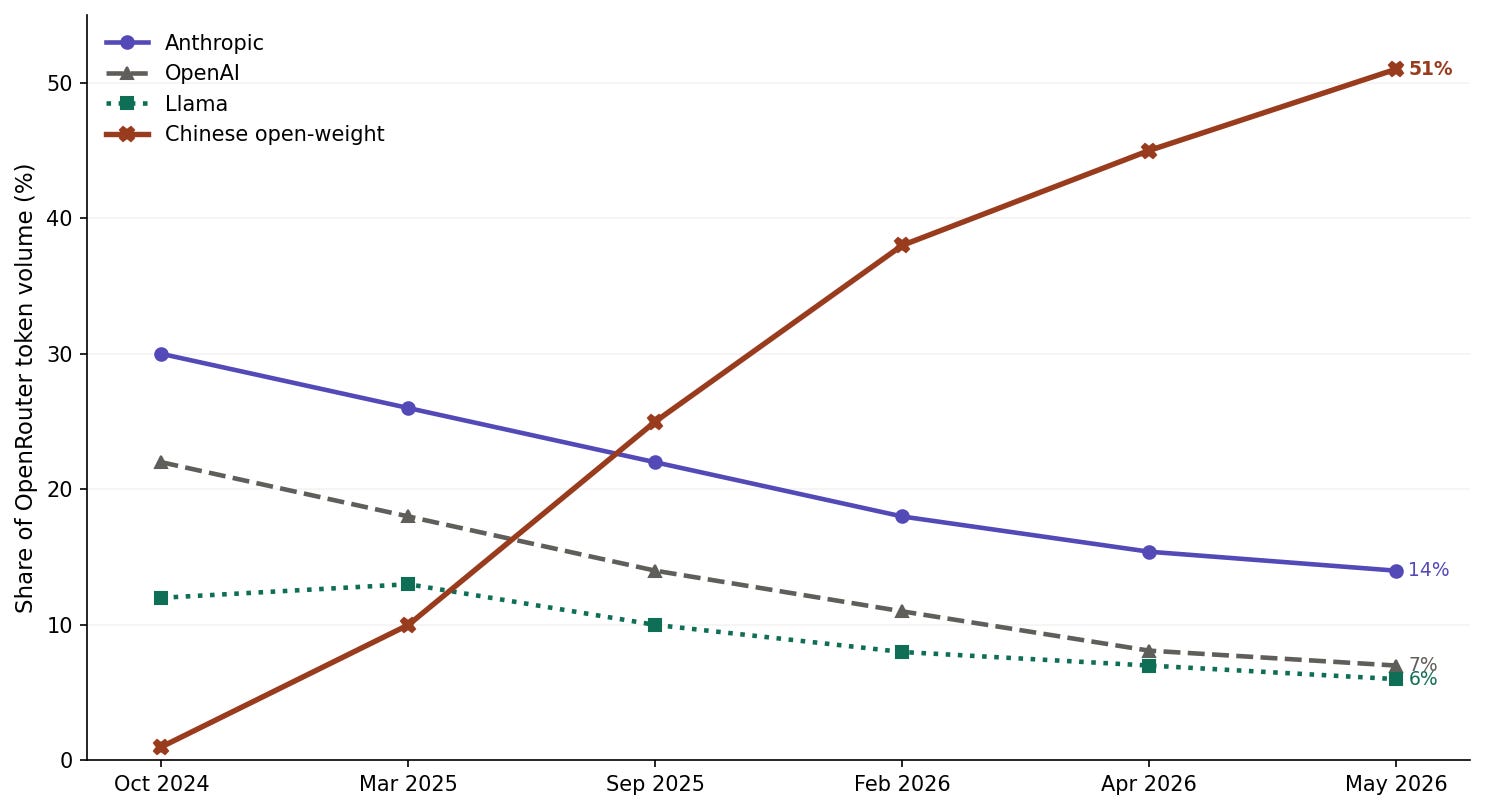
Anthropic, OpenAI, Llama, and Chinese open-weight share of OpenRouter token volume, October 2024 to May 2026.
The frontier premium is earned on reasoning but does not survive cost-adjustment on production work, and the providers still charging frontier-tier prices are the ones absorbing the compression. Meta absorbed the training cost and gave away the weights. Frontier providers still have to price for theirs. The frontier cannot price against open weights. Anthropic is not structurally safe either, even with its different customer base. Its $965bn post-money valuation is built on charging frontier prices for the foreseeable future; the cap structure cannot survive that premium compressing without reconfiguration.6
Both leadership teams see this clearly. OpenAI’s revenue mix has shifted decisively toward ChatGPT consumer and business subscriptions over the API; Sam Altman has repeatedly framed OpenAI as a consumer company, and the “ChatGPT for Healthcare” launch is a destination product rather than a healthcare-capable API release. The strategic logic is to monetize the consumer franchise while API margins compress, with frontier-model capability as the moat that keeps the destination worth visiting. Anthropic has built around reasoning-depth differentiation and around the workloads that scale with frontier capability rather than against it: agentic systems, Claude Code, computer use, multi-step clinical reasoning, autonomous workflows the next-quarter distilled model cannot reach. Both bets are strategically coherent reads of where value will sit at the next generation. Neither bet rescues frontier-tier API margin on the workloads that are already getting in-sourced. The precedent is Cisco and Oracle.
Both companies responded coherently to the substrate threat, and neither response prevented multiple compression.
Cisco’s original business was selling proprietary networking hardware (routers and switches) with high-margin lock-in on a proprietary network operating system. When hyperscalers started building their own switches running Linux-based network operating systems on commodity hardware, Cisco moved up-stack into software and services it could still charge full price for: Webex (video conferencing, acquired in 2007), AppDynamics (application performance monitoring, 2017), ThousandEyes (internet observability, 2020), and Splunk (observability and security analytics, 2024 for $28bn, the largest acquisition in Cisco’s history).
Oracle’s original business was selling a proprietary relational database that ran on proprietary Unix and served as the system of record for most large enterprises. When Linux started eating Unix at the OS layer and open-source databases (MySQL, PostgreSQL) eroded the database moat from below, Oracle leaned into platform lock-in: Oracle Unbreakable Linux in 2006 to capture Linux support revenue against Red Hat; the Sun Microsystems acquisition in 2010 ($7.4bn) absorbing Solaris, Java, and MySQL itself; and Oracle Cloud Infrastructure (OCI) launched in 2016 to compete with AWS as the substrate moved to cloud.
Both pivots were strategically coherent. Both worked, in the sense that the companies still exist and grew revenue. Neither stopped the multiple compression. The customer base in-sourced on Linux regardless of what either vendor did to monetize what was left.7 The strategic response cannot escape the substrate. The pivots are real; they do not stop the in-sourcing.
What differs between OpenAI and Anthropic is timing and shape. OpenAI faces the same mechanism as Cisco: customer in-sourcing of the substrate, vertical AI vendors instead of hyperscalers, Llama instead of Linux. Every vendor that follows Abridge takes per-token revenue off the platform; the compression has been in motion for 18 months at population scale. Anthropic faces the same mechanism as Oracle: locked-in enterprise revenue at a lower multiple but durable, the multi-decade compound that comes from procurement complexity and switching costs. Health systems and pharma do not in-source; they keep paying at the contract rate for years.7 Both OpenAI and Anthropic are growing ARR rapidly through this. Cisco grew through its compression too: the multiple compresses, the top line keeps growing, and they are the same arc.
Anthropic’s confidential S-1 lands at a $965bn post-money valuation against ~$47bn in annualized run-rate revenue, a roughly 20x sales multiple. OpenAI’s most recent secondary marks sit at $852bn against ~$20bn in trailing revenue, closer to 42x.6 Cisco peaked at 39x on ~$12bn of trailing revenue in March 2000 before the multiple compressed to roughly 5-6x over the 25 years it took to reclaim the share price; Oracle trades today at roughly 12x on $57bn in revenue, the high end of a 4-to-15x range over the past decade and well above its ~5x historical median.7 The arc this essay predicts puts OpenAI on Cisco’s path: entering public markets near Cisco’s peak multiple, growing revenue rapidly, and watching the multiple compress as the vendor base in-sources on the open-weight substrate. Anthropic enters closer to Oracle’s mature band already, which is the easier IPO setup but the harder long-run story. The multiple has less to fall. The customer franchise has to compound durably enough to grow the top line into a public market cap built on frontier pricing assumptions the buyer base will not always honor.
OpenAI has Cisco-shaped margin risk. Anthropic has Oracle-shaped lock-in risk.
The compression has somewhere to go. Open weights are the substrate. In healthcare specifically, Llama leads the cohort. Abridge on Llama 3, Perplexity on Llama 3.3 70B, and the npj paper on Llama 3.1 are the visible entries in a larger pattern. The 2025 healthcare AI literature shows a sharp bifurcation: GPT-4 dominates evaluation papers (65.7% of model mentions across 4,609 studies per a recent Nature Medicine systematic review), but Llama dominates the build-a-new-model layer where production lives. Me-LLaMA, MMedIns-Llama 3, Med42, OpenBioLLM-70B, Llama-3-Meditron, Llama-3-radiation-oncology, Llama-3.2-Vision-glaucoma, and the local Llama-Anonymizer in NEJM AI are all 2024-25 entrants. There is no equivalent list of GPT-4 or Claude derivatives because those models are closed. Zuckerberg and LeCun saw it first. Open weights are the substrate.8
The second beneficiary is the vendor survivors. Abridge built its own SLIM distillation method in 2023, before any vendor offered the capability as a product.9 It now runs the in-house stack that captures the gross margin that used to flow through to its frontier API provider. Its gross-margin trajectory differs from non-migrators by roughly 50 percentage points: the difference between software multiples and wrapper-company multiples. The Abridge-class companies that have made the migration are the durable winners of the compression. The wrapper companies that built quickly on frontier APIs without distillation infrastructure are the casualties.
For builders: the test is whether you can move your workload off a frontier API in roughly the time it takes the frontier to ship the next generation. Call it 24 months. You need a distillation pipeline, a labeled-data flywheel feeding off your real workload, and an internal model team that owns the migration end to end. If you do not have those pieces, the next contract repricing reaches you before you can route around it.
For investors: the picks-and-shovels play has moved one layer up the stack, to orchestration, evaluation, fine-tuning, and clinical-data curation. The role this layer would play is the Databricks of clinical AI: one platform where a healthtech vendor brings its clinical data, fine-tunes a model, evaluates and deploys it, and monitors it in production, all under healthcare-grade compliance. That company does not yet exist. General-purpose ML infrastructure vendors carry HIPAA compliance and serve some healthcare customers (Fireworks AI, Snorkel, Arize, Galileo, Predibase), but none integrate the healthcare-native clinical data layer and the clinical-workflow specifics into the training, evaluation, and deployment stack. Healthcare-native data platforms (Truveta, Datavant) have the data and the compliance but do not run those loops. Nobody has stitched the two halves together. The customer is not 6,000 hospitals; it is the few hundred vertical AI vendors who need to in-source their model stack to capture margin currently flowing to their frontier API provider. The wedge has to survive a 2027 first-party Anthropic or OpenAI clinical-tuning release.
OpenAI ends like Cisco. Anthropic ends like Oracle. Meta led the open-weight bet that became the substrate both arcs run on. Abridge’s 40% is the leading indicator. The rest of the sector is the lag.
Drafted with support from Claude as a research assistant with Perplexity and ChatGPT as a red-team.
Citations
Shiv Rao, interview with Harry Stebbings, The Twenty Minute VC (20VC), episode “The Five Year Desert to Product Market Fit & a $5.3BN Valuation with Shiv Rao @ Abridge,” May 16, 2026,
The 40% in-house figure and the open-source distillation framing appear in the model-strategy section (~18:30). The pulled quote (“Own your stack to protect your P&L and UX”) is from Rao’s LinkedIn post on the episode. Abridge funding position: Marina Temkin, “Shiv Rao’s Abridge has become the AI healthcare startup to watch,” Fortune, 2025 — Series E at $5.3bn post-money, the largest single round in the vertical clinical AI category at announcement. Abridge specific Llama deployment: Brad Genereaux, “Dozens of Healthcare Companies Adopt Meta Llama 3 NIM,” NVIDIA Blog, June 2, 2024, https://blogs.nvidia.com/blog/llama-3-nim-healthcare-generative-ai/ — Abridge is named building its physician-patient encounter summarization on the Llama 3 NIM. OpenAI healthcare partner status: OpenAI, “ChatGPT for Healthcare” launch materials (2026), naming Abridge, Ambience, and EliseAI as health tech partners.
Anthropic, “Advancing Claude in healthcare and the life sciences,” timed to the J.P. Morgan Healthcare Conference, January 11, 2026. Coverage: Heather Landi, “JPM26: Anthropic launches Claude for Healthcare to turbocharge AI efficiency at health systems, payers,” Fierce Healthcare, January 2026. Banner Health “BannerWise” 55,000-staff enterprise deployment per Banner-Anthropic case-study coverage, Q1 2026. Anthropic Partner Network composition per Anthropic, “Anthropic invests $100 million into the Claude Partner Network,” 2026.
Perplexity, “Meet New Sonar,” Perplexity Hub blog, January 2025, https://www.perplexity.ai/hub/blog/meet-new-sonar. Sonar is built on Meta’s Llama 3.3 70B base, internally trained and fine-tuned for search-answering, served via Cerebras inference at ~1,200 tokens/second. Premium tiers retain access to GPT-5, Claude, and Gemini for harder workloads.
Elizabeth Geena Woo, Michael C. Burkhart, Emily Alsentzer, et al., “Synthetic data distillation enables the extraction of clinical information at scale,” npj Digital Medicine 8, 267 (May 10, 2025), https://www.nature.com/articles/s41746-025-01681-4. 8B-All model achieved 89.30% accuracy on annotated synthetic trial criteria vs 76.20% for the 70B-Instruct teacher (Table 2). Cost for a 10,000-patient apixaban cohort: $929 (8B) vs $4,066 (70B) on the least expensive cloud provider (Supplementary Table 5). Paper evaluates information extraction, not generative ambient documentation.
OpenRouter LLM Rankings, State of AI 2025 report, and Series B announcement (May 2026). Sources: https://openrouter.ai/rankings, https://openrouter.ai/state-of-ai, OpenRouter’s May 2026 funding-round press coverage. Aggregate token throughput: ~5T tokens per week (late 2025), ~25T tokens per week (May 2026, equivalent to ~100T per month), representing roughly a 5x increase over six months per OpenRouter’s May 2026 Series B press materials. Provider shares as of April 2026: Anthropic 15.4% (down from a dominant first-place position in late 2024); OpenAI 8.1% with GPT-5.4 at approximately 0.98T tokens per week and seven other models ranked above it on weekly volume. Chinese open-weight cohort (Xiaomi MiMo-V2-Pro, MiniMax M2.5, Moonshot Kimi K2.5, Alibaba Qwen 3.6 Plus, DeepSeek): 1.2% (October 2024), roughly 10% (March 2025, post-DeepSeek V3), roughly 25% (Q3 2025, post-Kimi K2 / MiniMax), 45% (April 2026), 51.2% (May 2026). The chart anchors the verified data points (Chinese cohort Oct 2024, Mar 2025, Sep 2025, Apr 2026, May 2026; Anthropic and OpenAI Apr 2026); Anthropic, OpenAI, and Llama trajectories at other timepoints are directionally interpolated from the State of AI narrative. OpenRouter is a developer-routing aggregator. It does not include direct API traffic to Anthropic, OpenAI, Google, or Meta endpoints, nor inference on customer-hosted or vendor-distilled models. Share figures reflect builder adoption within the marketplace slice rather than total enterprise inference share; the cost-compression dynamic the marketplace approximates operates in those other slices as well.
Anthropic Series G: $30 billion raised at $380 billion post-money, February 12, 2026, per Anthropic, “Anthropic raises $30 billion in Series G funding at $380 billion post-money valuation,” and TechCrunch coverage. Anthropic Series H: $65 billion raised at $965 billion post-money, announced May 28, 2026, per NBC News and Axios coverage; this is the post-money figure cited in body ¶7. Sacra, “Anthropic revenue, valuation & funding,” May 2026, tracks ARR through both rounds. On OpenAI: $122bn raise at $852bn post-money valuation closed March 31, 2026 per OpenAI press release “Accelerating the next phase of AI” and Forge Global secondary-market indications (~$880bn implied as of April 24, 2026); $25bn annualized revenue as of February 2026, ~$24bn run-rate as of March 2026 per Sacra OpenAI tracking page. The multiples paragraph uses OpenAI’s ~$20bn trailing-twelve-month revenue figure (TTM lags annualized run-rate by 4-6 months in a fast-growing revenue line) per TradingKey, “Anthropic Pre-IPO Valuation of 965 Billion Surpasses OpenAI for the First Time,” 2026, https://www.tradingkey.com/analysis/stocks/us-stocks/261935293-anthropic-ipo-openai-claude-code-tradingkey. Anthropic Series H ARR figure of ~$47bn is per CNBC, “Anthropic tops OpenAI as most valuable AI startup, nears $1 trillion valuation in latest round,” May 28, 2026, https://www.cnbc.com/2026/05/28/anthropic-open-ai-startup-value.html, and TradingKey. Anthropic confidential S-1 filing per Jessica Mathews, “Anthropic confidentially files for IPO after raising $65 billion in a funding round at a $965 billion valuation,” Fortune, June 1, 2026, https://fortune.com/2026/06/01/anthropic-confidentially-files-ipo-965-billion-valuation/. Anthropic’s $965bn post-money exceeded OpenAI’s $852bn for the first time in May 2026 per the same CNBC and Fortune coverage. OpenAI revenue mix per Sacra (May 2026): ChatGPT consumer and business subscriptions (Plus, Pro, Team, Enterprise, Business, Edu) account for approximately 65% of total revenue, API access ~25%, and partnerships ~10%; enterprise customers are on track to reach parity with consumer revenue by end of 2026. Sam Altman has explicitly framed OpenAI as a consumer tech company; see Ben Thompson, “An Interview with OpenAI CEO Sam Altman About Building a Consumer Tech Company,” Stratechery, March 20, 2025, https://stratechery.com/2025/an-interview-with-openai-ceo-sam-altman-about-building-a-consumer-tech-company/. See also Alex Kantrowitz, “Sam Altman on OpenAI’s Plan to Win, AI Personalization, Infrastructure Math, and The Inevitable IPO,” Big Technology, 2025, https://www.bigtechnology.com/p/sam-altman-on-openais-plan-to-win.
Cisco Systems market capitalisation peaked above $555bn on March 27, 2000, briefly making it the world’s most valuable publicly traded company at ~39x trailing revenue. The 39x figure anchors to Cisco’s FY1999 revenue of $12.2bn (the most recently reported fiscal year as of the March 27, 2000 peak); annualized revenue was ramping toward FY2000’s $18.9bn at the time, so trailing-quarter multiples differ from headline trailing-year multiples by a meaningful gap. The stock then traded sideways for over two decades through multiple compression; revenue grew from ~$22bn (FY2001) to $56.7bn (FY2025). The share price did not reclaim its March 2000 split-adjusted high until December 10, 2025, by which point market cap stood at ~$317bn, implying a roughly 5-6x trailing P/S. Sources for Cisco: Cisco 8-K filings (revenue); CNBC, “Cisco’s stock closes at record for first time since dot-com peak in 2000,” December 10, 2025, https://www.cnbc.com/2025/12/10/ciscos-stock-closes-at-record-for-first-time-since-dot-com-peak-2000.html; Bilello tweet citing YCharts on 2000 peak P/S ratios; public market data aggregators (Macrotrends, public.com) for market-cap snapshots. Oracle comparator: Oracle FY2025 total revenue $57.4bn per Oracle Corp, “Oracle Announces Fiscal 2025 Fourth Quarter and Fiscal Full Year Financial Results,” June 11, 2025, https://investor.oracle.com/investor-news/news-details/2025/Oracle-Announces-Fiscal-2025-Fourth-Quarter-and-Fiscal-Full-Year-Financial-Results/default.aspx. Market cap ~$717bn as of June 2026 per TradingEconomics, implying ~12.5x trailing P/S. Oracle’s 10-year P/S range is 3.78 to 15.06 with a median of ~5.27 per GuruFocus and Macrotrends historical data; the current ~12x sits near the high end of that band, reflecting re-rating on cloud and AI infrastructure narratives, while the long-run median ~5x is the more relevant anchor for a mature-state endpoint. Cisco’s strategic response to Linux/white-box in-sourcing, by acquisition: Webex ($3.2bn, 2007), AppDynamics ($3.7bn, 2017), ThousandEyes (~$1bn, 2020), Splunk ($28bn, closed March 18, 2024 — Cisco’s largest deal in four decades, per the Cisco-Splunk close press release at https://www.splunk.com/en_us/newsroom/press-releases/2024/cisco-completes-acquisition-of-splunk.html). Oracle’s strategic response: Oracle Unbreakable Linux launched October 2006 as a Red Hat-compatible distribution with $99/system support pricing per Oracle’s October 2006 OpenWorld announcement (see Oracle Linux history, https://en.wikipedia.org/wiki/Oracle_Linux); Sun Microsystems acquired for $7.4bn, closed January 2010 (delivering Solaris, Java, and MySQL); OCI launched 2016 and now constitutes a material and growing portion of Oracle’s revenue mix per Oracle 8-K filings. Both companies’ pivots were strategically coherent but the multiple compressed regardless, which is the precedent the essay’s body paragraph anchors to.
2025 healthcare AI literature bibliometric scan, May 2026. Macro evidence: Nature Medicine LLM-assisted systematic review of 4,609 clinical-medicine LLM studies through September 2025 (OpenAI/ChatGPT 65.7% of evaluated models; Gemini/Bard 13.1%; Llama family ~7%), https://www.nature.com/articles/s41591-026-04229-5. Llama-derivative medical foundation models named: Me-LLaMA (Xie et al., npj Digital Medicine 2025, Llama 2 base), MMedIns-Llama 3 (Wu et al., npj Digital Medicine 2025), Med42 (Llama 3 base), OpenBioLLM-70B (Llama 3 base; 86.06% average across nine biomedical benchmarks), Llama-3-Meditron, Llama-3-radiation-oncology (peer-reviewed 2025), Llama-3.1-biomedical-QA (medRxiv 2025), Llama-3.2-Vision-glaucoma (peer-reviewed 2025), LLM-Anonymizer (NEJM AI 2025).
Mrigank Raman, Pranav Mani, Davis Liang, Zachary Lipton, “For Distillation, Tokens Are Not All You Need,” NeurIPS 2023 Workshop on Instruction Tuning and Instruction Following, OpenReview, November 2023, https://openreview.net/forum?id=2fc5GOPYip. Three of four authors (Mani, Liang, Lipton) are Abridge-affiliated. Introduces SLIM (Sparse Logit Infused Modeling): distillation using the top-5% highest teacher logits with dynamic weighting of KL divergence and cross-entropy loss.
very interesting! the only point we would bring up for discussion is the idea of immovable. Meta is dominant for hospitals running their own infra. Epic + Mayo Clinic just integrated GPT-4 deeply, so the real idea is bifurcation not Meta dominance.