


10 min read
This document is a free sample. It’s part of larger three part series on
Venture Funding for Fun and Profit
(Free Subscribers) How to build a pitch deck and startup narrative
(Paid Subscribers) How to find investors and run an angel or pre-seed process
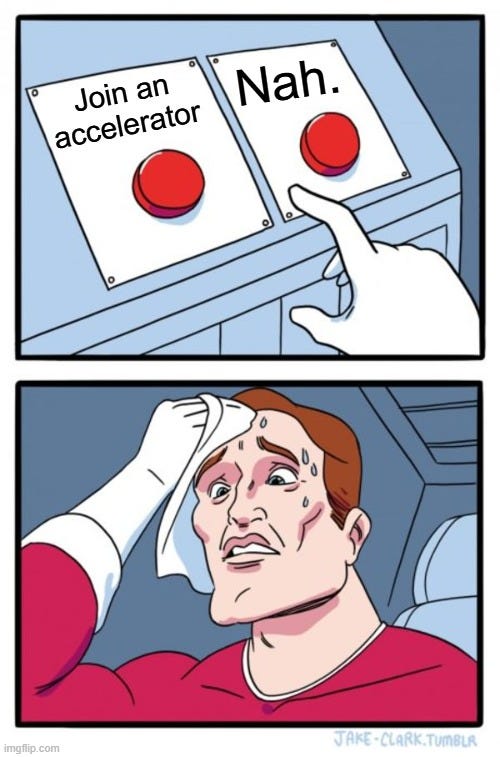
TLDR: Do your best to get into a top decile accelerator. They’re genuinely helpful. Otherwise, you’re better off spending those 3-4 months focused on fundraising, product, and biz dev.
For an under-networked clinical founder, an accelerator is often pitched as the alternative path through friends-and-family and angel: a program that promises to manufacture the qualified investor funnel, the health-system intro graph, and sometimes a first pilot in one move.
The largest global study (8,580 startups, 408 accelerators) finds that participation roughly doubles the probability of raising venture capital, from a ~3% baseline to ~6.4%, and adds about $1.8M to first-year funding [1].
But subsequent matched-pairs research (~900 graduates vs ~900 non-participants) shows the first-year bump dissolves: over the three years after graduation, graduates raised about $9M less in total funding, were more often acquired in talent-driven acqui-hires than technology acquisitions, and shut down earlier and more often [2].
A long tail, not a bell curve.
Underneath both findings sits a comet distribution of accelerator outcomes. Top-tier programs delivered large gains, second-tier delivered beneficial learning, and bottom-tier programs actively inhibited venture development along some dimensions [3]. The accelerator average (+2x funding likelihood) is the wrong unit to plan against; the specific program is.
The vantage for what follows: I ran the Catalyst and Innovention Accelerators at NYU Tandon Future Labs for four years, and Steve Kuyan, now my venture partner at Mighty Middle Ventures, ran them for eleven before me. We supported 300+ teams who went on to raise $2.7B and produce 44 exits (a 15% outcome rate). I have watched multiple Catalyst and Innovention alumni go on through Techstars, Y Combinator, a16z Speedrun, Forum, ERA, and many others, which means I have seen the same companies before and after the brand-name programs and can compare what those programs added.
Empathy demands that we reject mediocre accelerators
I learned this myself. As a young founder I was considering a nationally known healthtech accelerator network, since thankfully shuttered. Before applying, I reached out to alums. Nine in ten told me their time there had been a complete waste, and I did not apply. The information was already in the community. It was sitting in the peer network rather than in the marketing copy. The community knew. The community had no way to say so to the next founder.
Personal runway is finite. Spousal tolerance is finite. The patience of friends-and-family backers is finite. A mediocre accelerator that absorbs three to four months of that scarce resource does damage that does not show up in the program’s own metrics: the founder still finished demo day, still got the certificate, still appears in the alumni count. What is missing from the count is the venture that might have raised, sold, or pivoted in those same months.
Brad Feld’s Startup Communities lays the cornerstone for how regional ecosystems work. Entrepreneurs lead. “Feeders” (universities, government, investors, service providers) support. Feeder-led programs that misallocate founder time and credibility do real damage to the community as a whole. Feld’s “give first” ethos functions as a normative filter; actors who extract more than they contribute should not become central figures. Even if Feld does not say it in those words, bad-actor accelerators need to be identified and named. A community that protects its mediocre programs out of misplaced civility is failing its founders.
My proposed framing is as follows.
If a startup accelerator fails to get at least 50% of its teams attributable follow-on funding or a substantive attributable new contract within 3 months of graduation, that accelerator is likely doing more harm than good by absorbing precious and finite founder runway.
There are 500,000 active angels around the world. If a program couldn’t shape and nurture 50% of it’s teams into a form factor that a handful deem fundable, that is an outright failure.
The kinder posture is the harder one. Empathy for founders requires the community to tell them when a program is mediocre, even when the program is run by well intentioned operators. The alternative, letting those programs absorb founder runway in the name of being supportive, is a failure of empathy dressed as collegiality.
The Hedging Accelerator
One model to screen out, and it’s a newer one gaining ground: the hedging accelerator. It admits a large cohort but only invests in, and takes meaningful equity from, a fraction of it, never more than 30% of the teams. The rest get the standardized programming and the demo day.
The bet is rational for the accelerator: three to four months of close-quarters work gives them a strong read on both your team and your customers, so they back the few they come to believe in. The risk lands on you, and it’s a signaling one. You’re far more likely to sit in the cohort’s “not funded” slice than its “funded” one, and you’ll spend real effort in your next round explaining to investors why the accelerator that watched you for a quarter chose not to write the check.
MD matters more than the brand.
The brand on the accelerator is a wrapper. The implementation is the work of the managing director, and that’s where the variance lives. The cleanest example in the literature: one accelerator ran two cohorts a year apart — one produced strongly positive effects on fundraising and employment, the other reduced participants’ web traffic during the program and showed no detectable effect on fundraising. Same brand, opposite outcomes, twelve months apart. The accelerator effect lives in program design and operator quality, not in the marquee.
What the MD controls and the brand book doesn’t: mentor recruiting, cohort selection, which VCs come to demo day, whether your time gets protected or strip-mined. I’ve mentored at six Techstars affiliates and the founder experience varies enormously across them. The diligence question isn’t “is this a well-regarded brand?” but “who’s the MD, how long have they been here, and can I talk to alums from THEIR last two cohorts?” A famous logo with an MD who arrived nine months ago is a brand-new program.
Geography Matters, but not How You’re Assuming
Location matters far less than founders assume, and the MD point is most of the reason why. For many years I felt the two best healthtech Techstars programs were LA, led by Matt Kozlov, and Fort Worth, where Trey Bowles was managing director and Jordan Warnement ran the program. I volunteered my time with the Fort Worth team and was given their all-star mentor award, so I am not neutral, but the quality of that program had nothing to do with being in Fort Worth rather than a coastal hub.
Fort Worth Techstars has since shuttered. Trey now runs 1845 Ventures, a dedicated healthtech fund and studio in Fort Worth. I would assume without hesitation that the thoughtfulness, drive, and wisdom he brought to Techstars teams is still there. The brand on the door changed; the operator did not.
The geography that does matter is your customers’, and it cuts the opposite way from intuition. Seth Weill, formerly an investor on the venture team at Mount Sinai Health System in New York City, gave my portfolio companies the consistent advice: raise in the major metros, but find your payer and provider customers elsewhere. VPs of utilization at payers and CMIOs at hospitals in major metros are desensitized to local teams pitching them the latest widget. A hospital in Louisville or Tulsa is no less relevant as an anchor customer, and is often a more willing one. Pick a program for its MD and network, not its zip code, and run your commercial motion where the buyers still pick up the phone.
Incidentally, Seth has taken a version of his own advice. As of June 2026, he has left Mount Sinai Ventures to build healthtech ventures at General Catalyst in Ohio. GC has effectively infinite money and dedicated teams in NYC and SF. Despite this, they chose to buy a health system as their innovation petri dish in the Midwest.
But they promised me contracts?
Be especially skeptical of the promised buyer access, because the health-system programs are where it underdelivers most.
Here are two anonymized examples, both from brand-name hospital accelerators and where I have direct knowledge of how things played out.
At one major east coast academic medical center, the accelerator’s venture arm was completely separate from the clinical service lines, and the service-line leaders got annoyed enough at cohort teams running customer discovery against their staff that they capped how senior a person any startup was allowed to talk to. Sell-through to the host system was poor as a result: the program could get you in the building, but not past the org chart.
The second case is subtler and more expensive. A device team went through a brand-name accelerator at a major coastal hospital system with a tool focused on Emergency Department usage. The ED’s medical director loved it, and the CFO loved it enough that the hospital invested in the company off its own balance sheet. Then purchasing ran the numbers: this category of device came as part of a vendor bundle, and dropping the incumbent’s clearly inferior ones would have repriced everything else in that contract. Even with top-to-bottom leadership support, the system bought two cartons, ever. A hospital can love your product, invest in your company, and still be unable to buy it, and the accelerator’s promised buyer access does not survive contact with procurement.
Before you join any program, run two checks.
Talk to founders from the most recent cohort, not the alumni the program puts in front of you. Last cycle’s teams know what it delivered before a good exit rewrote the story, so ask them what happened when their raise went quiet and who opened a door.
Treat the managing director and the program manager as two advisors you’d have to pay in equity, and ask whether you would.
A program is its MD and its program manager. Ninety percent of the value you’ll derive from an accelerator is driven by those two people, and this holds even at the YC level: the teams I’ve worked with have had vastly different experiences depending on which YC partner they drew. If those two aren’t worth advisor shares on their own merits, the brand and the demo day won’t change that.
A template for reaching a recent-cohort founder cold:
“Hi [Name],
I’m applying to [program]’s next cohort. Would it be possible for us to connect? I’d love to hear about outcomes and experiences from someone who just went through the program.
Two questions: 1. what did the program actually do for your raise when it got hard, and 2. would you do it again knowing what the equity and time cost? Fifteen minutes by phone whenever’s easy would be hugely helpful. I’m available [option 1], [option 2], or [my calendly].
Please feel free to share your calendar and and I can grab time if that would be more convenient.
Thanks!
-New Founder”
Be honest, too, about why you’re joining. If the answer is to learn how to sell B2B enterprise into healthcare, an accelerator is an expensive way to do it. Three resources will teach you more in a week of evenings:
Julie Yoo’s go-to-market playbooks for digital health startups at a16z Bio + Health, the cleanest single resource on commercial design for digital health [4].
Koby Conrad’s “6 Growth Channels That Actually Work”, by Rupa Health’s then-head of growth, who scaled the platform from $5M to $75M in annualized lab sales before founding his own company [5].
A 2023 workshop I ran on selling to health plans, with Jacob Victory (former Centene executive) and Bobby Murphy (a sales lead with exclusive Medicaid-plan experience) on the panel, and a fireside chat moderated by Rohan Siddhanti, then GTM lead at the EHR Healthie and now in a healthtech GTM role at Anthropic [6].
Or wait for the B2B healthtech GTM field guide I’m publishing in late July. The equity an accelerator costs is worth it for the MD and the network behind the program. It’s rarely worth it as a place to learn enterprise sales.
Even the best accelerators don’t replace a fundraise
The dollars that you get from most programs will not replace the need to run a dedicated fundraise after demo day.
Raising from angels and pre-seed funds is entirely doable even without an accelerator on your cap table. This document is part of a series of field guides that I’ve written on the topic through the lens of having coached MANY successful founders.
(Free Subscribers) How to build a pitch deck and startup narrative
(Paid Subscribers) How to find investors and run an angel or pre-seed process
If you join, three pieces of advice
I ran these programs for years, so let me close with the advice I gave every team I took on. All three come down to the same thing: a program can only help with what you put in front of it.
Be the squeaky wheel. When you ask, a good director and their team will bend over backward to get you the intro, the mentor, the contact, whatever you need. We can’t read minds. If you don’t tell us what you’re stuck on, we can’t unstick it.
Tell us when things are going wrong. Teams break up, commercial champions change roles, roadmaps drift. We can’t help with what you don’t share, and the problems you hide are usually the ones that sink the round.
Do the work. Showing up for the PMF seminars and demo day and nothing else is a waste of everyone’s time. The best outcomes among my teams came, every time, from the founders who actually showed up and did the work between the sessions.
References
Valentina Assenova & Raphael Amit, “Poised for Growth: Exploring the Relationship Between Accelerator Program Design and Startup Performance,” Strategic Management Journal 45(6), 1029-1060, 2024. 8,580 startups across 408 accelerators in 176 countries (GALI data, 2013-2019). Accelerator participation roughly doubles the probability of raising venture capital (from ~3% baseline to ~6.4%) and adds about $1.8M to first-year funding. Peer-reviewed. Comparator is other applicants, not a clean experiment; the positive headline average is built on a highly unequal distribution dominated by a small cluster of strong programs. https://doi.org/10.1002/smj.3581
Sandy Yu, “How Do Accelerators Impact the Performance of High-Technology Ventures?” Management Science 66(2), 530-552, 2020. Matched-pairs design comparing ~900 accelerator graduates against ~900 non-participants. Three years after graduation, graduates raised about $9M less in total funding, were more often acquired in talent-driven acqui-hires than technology acquisitions, and shut down earlier and more often. Yu’s framing: accelerators “resolve uncertainty around company quality sooner, allowing founders to make funding and exit decisions accordingly.” Peer-reviewed. The first-year bump dissolves over the 3-year horizon; compressed time-to-clarity, not compounding capital, is the real product. https://doi.org/10.1287/mnsc.2018.3256
Benjamin L. Hallen, Susan L. Cohen & Christopher B. Bingham, “Do Accelerators Work? If So, How?” Organization Science 31(2), 378-414, 2020. Accepted-versus-almost-accepted design at a set of top US accelerators, controlling for startup quality. Some but not all programs aided venture development: top-tier produced large gains, second-tier delivered beneficial learning without the sorting/signaling premium, and one of the studied programs actively inhibited venture development along some dimensions. Mechanism credited: “broad, intensive, and paced consultation.” Peer-reviewed; accepted-vs-almost-accepted quasi-experimental design. https://doi.org/10.1287/orsc.2019.1304
Julie Yoo (a16z Bio + Health), “The New Go-to-Market Playbooks for Digital Health Startups.” The cleanest single resource on commercial design for digital health. Named-investor essay; fetched in full. https://a16z.com/the-new-go-to-market-playbooks-for-digital-health-startups/
Koby Conrad, “6 Growth Channels That Actually Work” (video). Conrad scaled Rupa Health from $5M to $75M in annualized lab sales as its head of growth before founding his own company; a masterclass in multi-channel healthtech B2B sales. Disclosure: I’ve sent this to many founders and invested in Conrad’s friends-and-family round.
Vadim Gordin, “Selling to Health Plans,” 2023 workshop (video). Panel with Jacob Victory (former Centene executive) and Bobby Murphy (a sales lead with exclusive Medicaid-plan experience), and a fireside chat moderated by Rohan Siddhanti (then GTM lead at the EHR Healthie, now in a healthtech GTM role at Anthropic). First-person workshop.