



Contents
How Kinetic created and then won a category — the worked example before the framework.
The framework for effectively owning risk — five conditions, three stages, five failure modes, four diagnostic instruments.
Value-based care economics are often bad. Yours do not have to be — owned-loss economics vs. savings-share economics.
Three failures, three modes triggered — Bright, Cano, Babylon.
CareBridge — a narrow-population exit consistent with the framework.
Part 2 ships July 15: maternity through four different concepts of risk and venture design (Fetal Pillow, Maven, Pomelo, Ouma + MedArrive), a nine-question diligence memo for evaluating risk-bearing projects, and the venture-scale path through the framework.
TLDR: Take responsibility only for losses you can define, measure, materially influence, price with credible data, and survive when the model is wrong.
1. How Kinetic created and then won a category
My favorite startup example of a both wearables and owning risk is almost never discussed in the healthtech startup ecosystem.
Kinetic Insurance is an NYC company living the VC-funded dream. It created a new multi-billion dollar category that it now dominates. It did so by providing ground truth capable of dramatically beating the relevant actuarial tables and an effector arm for delivery both human and economic impact at scale. Most healthtech companies that announce a path to risk-bearing never even come close to reaching those destinations.
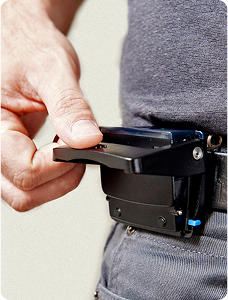
The Kinetic Reflex sensor detects high-risk lifting and bending postures among warehouse workers. When it sees one, it provides haptic feedback to the worker in real time. The accompanying software shows managers where risk is clustering by department, job type, and time of day, creating something employers rarely have: ground truth about how work is being performed. The employer value proposition is therefore twofold: fewer injuries and lost workdays, plus a usable map of the behaviors likely to produce the next injury. The product is not merely a warning buzzer; it is a sensor-to-coaching-to-management system aimed at a specific workers’ compensation loss.
Kinetic launched in 2014 as a workplace-safety wearable. By November 2021 it had launched Kinetic Insurance, a workers’ compensation program sold and serviced by Kinetic, with Nationwide’s excess-and-surplus and specialty organization underwriting the policies. Unsurprisingly, Nationwide Ventures has been involved with Kinetic since its 2020 series A.
Most healthtech companies that claim a path to “taking risk” never leave the much lower-margin strata of vendor economics. Some reach outcomes-priced contracts where a performance fee can be lost while the payer still owns the medical claim. Some accept capitation and bear delegated medical-cost downside. A much smaller group administers an insurance product. “Taking risk” collapses these into one sentence; this field guide separates them.
What Kinetic did is still the rare thing: it satisfied the operating and evidentiary prerequisites in sequence, in public, before moving into a delegated insurance role. The sequence is applicable and deeply instructive even when the strategic endpoint differs.
The loss event Kinetic addressed (strain and sprain claims in industrial work) is unusually well-suited to risk-bearing: a compensable injury is observable, maps to the policy and employer, settles inside the policy period, has decades of workers’-comp actuarial baseline, and posture, lift technique, repetition, and workstation design are operationally addressable.
In Section 2, we’ll work through these properties as the five conditions for a successful risk program, how Kinetic’s venture design passes each, and what new lessons new teams can apply to their own work.
