


Hi, I’m Vadim.
Healthtech venture is hard, a fact I’ve learned firsthand as an operator, accelerator director, and investor. I’ve watched too many good teams repeat avoidable mistakes others have already paid for. I write Healing Healthtech to distill research and the experiences of top-tier operators into actionable tactics and frameworks, so we can all aim to make only new mistakes.
Subscribe for a twice-monthly dispatch of free and paid field guides meant to help you build more deliberately toward something better in human health. And if it’s useful, please forward it to other healthtech builders in your network.
Drafted with support from Claude as a research assistant, with GPT and Gemini as a red-team.
Angel rounds are achievable. Anywhere in the world.
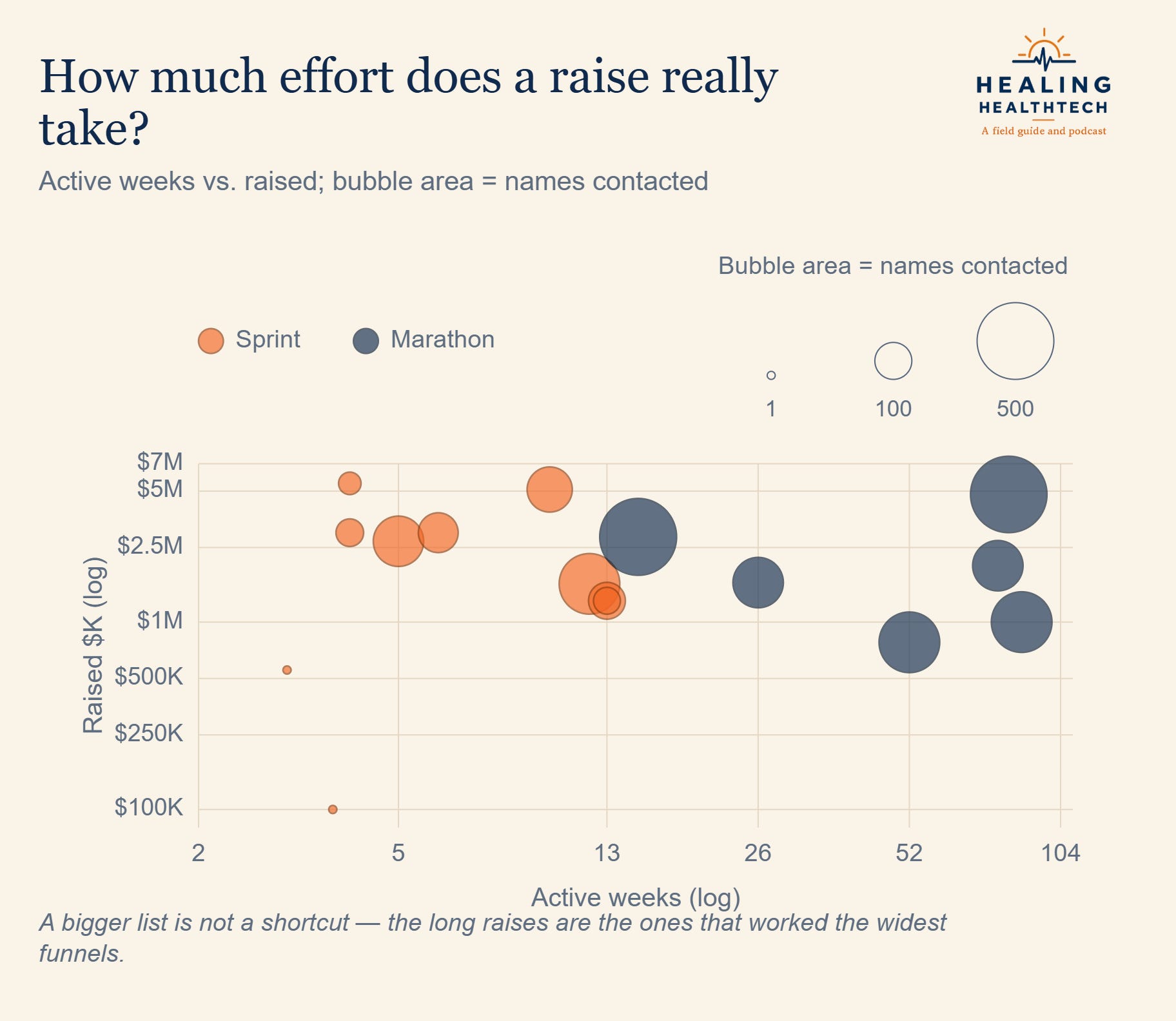
Every bubble in that chart is a real raise from a verified founder account [22]. Read it as a promise and a warning at the same time: angel rounds close at every size and on both sprint and marathon clocks, and none of them closed without sustained, disciplined effort against a wide funnel.
Angel investors aren’t magical. They’re mid-to-late-career professionals who remember what it was like to be a fresh builder, and who are now interested in and able to bet on younger founders in exchange for some of those founders’ upside. Most angels underwrite 1-3% of the deals they see, when they feel they have met a pitch that embodies their beliefs about founders, problem, and solution spaces [17]. Roughly 500,000 angels will fund some 60,000 companies around the world this year [38]. The goal of this guide is to help you find yours.
So when an angel raise fails, it fails for one of three reasons:
The founder never ran a disciplined process.
Something is fundamentally wrong with the plan or the proposed business.
The founder didn’t adapt the plan, the pitch, and the angel targeting as the process taught them things.
The first and third are fixable with method, and this guide is the method.
Over 15 years, my venture partner and I led the Data Future Lab at NYU, where we supported 300+ teams to $2.7B in capital raised and 44 exits; this guide exists to put that playbook in the hands of the thousands of founders I’ll never meet. It is keyed to my core domain of digital health, but I have personally coached teams running these exact strategies on thin films for solar panels, fintech SaaS platforms, and math tutoring programs for charter schools.
Part I — The map
The stages — the capital ladder, what each round buys, and the markup principle that runs through all of them.
The strategic fork: growth versus viability — know the plan at the start of the round, lock the choice with no less than 50% runway remaining, and run the next-round-investor diagnostic before you commit to growth.
Raising less money is not easier — the small-round trap, quantified, with the healthtech amplifier.
What makes a fundable healthtech company — the scale math, the operational machine, the acquirer pool, and the credibility tells.
Accelerator or nah? — when a program is worth the equity and when it isn’t; the comet distribution, the hedging-accelerator model, two diligence checks, and my advice from getting the most out of a program.
Part II — The process (phases run in parallel, not in sequence; a given investor sits at a different phase on any given day)
Phase 0: Set the table — vesting, 83(b)s, IP assignments, cofounder splits, option pool, the data room.
Phase 1: Build your list — finding 80-120 qualified names when your network is thin; the warm-intro priority stack.
Phase 2: Before you’re raising — meeting investors months ahead; lines, not dots.
Phase 3: Decide the round — price, instrument, size, founder salary, the procurement-cycle runway.
Phase 4: Choose your outreach pattern — the sprint versus the marathon, the forwardable, the investor-side comparator funnels.
Phase 5: Work the conversation — format for your first call with a new prospect, cadence, reverse diligence, reading and responding to the slow no.
Phase 6: Diagnose and calibrate the raise — the two-stage instrument, reading the clock and the funnel, asking the angels who passed, recalibrating before you scale.
Phase 7: Close and collect — stack checks behind your first investor, collect every yes the day it lands, the staged close, the SAFE stack, strategic checks.
Part III — The data — aggregate data sources organized by what you can dig into, with link-outs.
References
